Thailand removes both of the costs that usually punish solo travellers: a private room costs roughly what a dorm bed costs in Europe, and food is priced per dish rather than per table.
The accommodation maths
| Type | Nightly |
|---|---|
| Hostel dorm | ฿200–400 |
| Guesthouse private room | ฿400–800 |
| Mid-range hotel | ฿1,200–2,500 |
A private room with air conditioning for €12–20 means the choice between social and private stops being a financial one.
Many hostels have both, so you can take a private room and still use the common areas.
Eating alone is the default
Street stalls, food courts and small local restaurants are full of people eating alone.
40–80 baht a dish, ordered one at a time, with no format that assumes a group.
Mall food courts — Terminal 21, MBK — use a card system: load money at a counter, spend it at stalls, refund the balance. Air conditioned and completely anonymous.
The queues of Thai office workers at lunchtime are the recommendation.
The route
Bangkok — two or three days, with hostels concentrated around Khao San and increasingly in better-connected districts near the BTS.
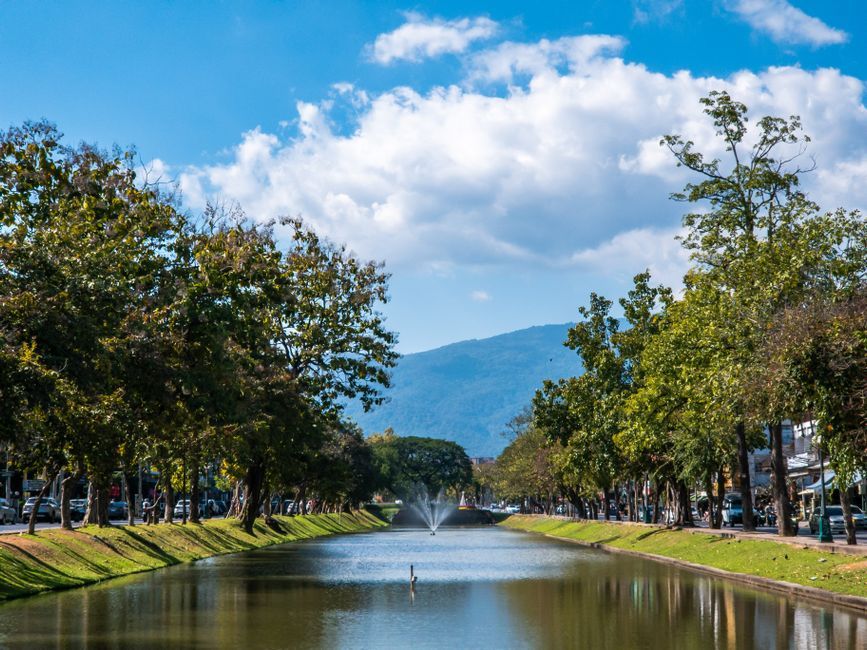
North to Chiang Mai — the most established long-stay and solo city in Asia, with cooking classes, temples, trekking and a dense café culture.
Pai, three hours further, small and heavily backpacker-oriented.
South to the islands, choosing the coast by season — the Andaman side is wettest May to October, the Gulf side around October to December.
Koh Tao for diving courses, which are among the cheapest in the world and are the single most reliable way to meet people on a solo trip.
The activities that are naturally social
A cooking class, which includes a market visit and ends with everyone eating together.
A diving course, where you spend four days with the same small group.
Island day trips, booked locally the day before for roughly half the online price.
Muay Thai training, available to beginners by the session in Chiang Mai and on the islands.
The scooter warning
The most important practical point.
Scooter accidents are the most common cause of serious injury to visitors in Thailand.
You legally need the correct motorcycle category on an international driving permit, and almost all travel insurance voids cover for an accident without it — meaning a hospital bill or an air ambulance paid personally.
Rental shops hire to anyone; they are not carrying the risk.
Never leave a passport as a deposit. Offer cash or a photocopy, and photograph the vehicle thoroughly first.
The burning season
Roughly February to April, when agricultural burning makes air quality in Chiang Mai and the north genuinely poor.
It coincides with what otherwise looks like the ideal dry season. Check forecasts before planning a northern trip in spring.
Practical
Visa exemption periods vary by nationality and have changed in recent years; check the current position.
$25–35 a day is comfortable including a private room.
Temple dress code — shoulders and knees covered — and never point your feet at a Buddha image.
The temple closed scam — someone says the Grand Palace is shut and offers a tuk-tuk itinerary. It is not shut.